
go-httpbin
Inspect HTTP requests and test status codes, redirects, headers and form submissions. No database required.
go-httpbin + Wasmer
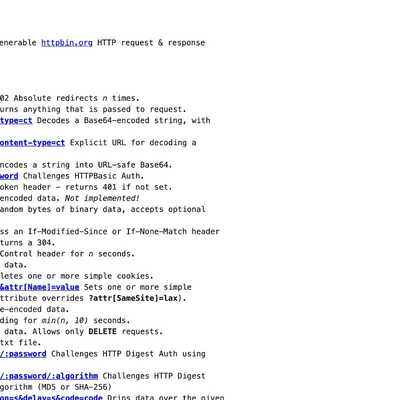
Run your own HTTP testing service with go-httpbin: inspect requests, echo JSON, follow redirects, and generate HTTP status responses. The upstream endpoint directory and response pages are served unchanged.
Demo
Deploy this example to get a live URL. Open / for the upstream endpoint directory, /get?message=hello to inspect a request, /redirect/2 for a redirect chain, or /status/418 for a test error response.
How it Works
go.modpins upstream v2.25.0, whose owngo.modrequires Go 1.25.0.go.sumverifies the module content; no@latestdependency is used.main.goserves the upstream handler on0.0.0.0:$PORT, defaulting to8080. The app needs no database, external service, persistent storage, GPU, or API key.- Upstream embeds its original HTML, styles, forms, and image assets into the Go module. This template adds no replacement page, controls, or styling.
- The
Anybuildrecipe compiles the app and includes its MIT license in the runtime package. The repository-rootAnybuild.go-httpbinloader supports monorepo builds with--subdir go-httpbin. - Wasmer builds use the WASIX-enabled Go compiler selected by Anybuild. Ordinary Go's
wasip1compiler does not establish HTTP server compatibility; a successful native build alone is not a Wasmer deployment test.
Running Locally
Use Go 1.25 or newer:
go mod download
mkdir -p .cache
go build -trimpath -o .cache/go-httpbin .
PORT=18127 .cache/go-httpbin
Open http://127.0.0.1:18127/. With the server running, check the core endpoints:
python3 scripts/check.py http://127.0.0.1:18127
The nine smoke cases cover the upstream home page, query/header inspection, JSON POST, reflected header filtering, redirects, and status responses. The same script accepts a deployed HTTPS URL.
Configuration
PORT: listening port, default8080.ALLOWED_REDIRECT_DOMAINS: comma-separated external hosts permitted by/redirect-to, defaultexample.com. Relative redirect endpoints work normally.- Generic request-header reflection excludes
AuthorizationandCookie. Dedicated upstream authentication and cookie endpoints retain their normal behavior. - Upstream defaults bound request/response bodies to 1 MiB and generated delays to 10 seconds. This is a request-testing app, not a persistent webhook inbox.
Deploying to Wasmer
Import https://github.com/wasmerio/examples and select go-httpbin as the application root, or upload this self-contained folder. Keep the supplied Anybuild definition so the Go compiler and start command remain explicit.
For a local Wasmer build with Anybuild 0.26.4 and a Docker-compatible builder:
anybuild build . --wasmer --docker
anybuild run . --wasmer --start
From the repository root, inspect the monorepo configuration with:
anybuild plan . --subdir go-httpbin --wasmer
The build/run commands prepare and run locally; they do not publish an app. Hosted deployment, browser review, WebSocket echo, streaming, and the complete upstream endpoint catalog must be verified separately rather than inferred from the core HTTP smoke cases.
License and Upstream
go-httpbin is copyright Will McCutchen and uses the MIT license. The template uses the same license and preserves that notice in LICENSE, which is also copied into the deployed package. Canonical UI references are the pinned upstream endpoint directory and POST form.
